Skip to contentRepaplexrepair or replace, decided by the numbersAutomatic follows the operating system setting. Light and dark override it and are remembered in this browser.
commercial washer: a stacked or shared washer in a building laundry that is leaking
The machine in an apartment laundry room is usually the same domestic washer a house has, and the publisher's own finding is that nothing on it fails differently under commercial use - everything fails sooner. What changes with the building is not the fault list but the cost of reaching the fault: nothing on the washer can be touched until the dryer above it has been uncoupled and lifted clear, and that is where the diagnosis starts. The visit is what the money goes on here: $150 [S1] covers the diagnostic alone, and only 5 of the 6 causes on this page need a part at all. The complaint is a stacked or shared washer in a building laundry that is leaking, described as water is pooling under the machine in the building laundry room, the door boot is black and the floor is wet after every cycle, a tenant reported water running out into the hallway, the same machine has leaked three times this year or the laundry room floor is wet and the machine still runs. A front loader door boot seal that never gets the chance to dry out is where to start — about 45 minutes, with no published price for the part [S1].
What the fault looks like
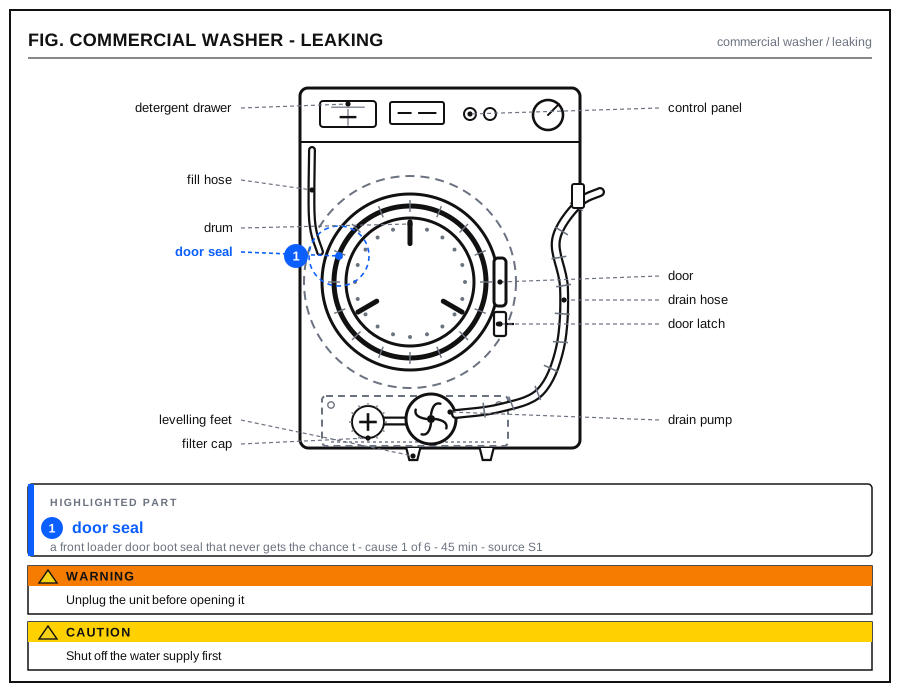
Fig. COMMERCIAL WASHER - LEAKING
What a technician actually does
a front loader door boot seal that never gets the chance to dry out [S1]
high likelihoodmediumnot pricedabout 45 min
the door boot is black and the floor is wet after every cyclethe same machine has leaked three times this year
The leak the publisher names first for this population, and the one it says tenants can genuinely prevent. Continuous use means the door is rarely left open to dry, so the seal stays damp, degrades and eventually either leaks or grows mould - which is the same failure the residential record describes, arrived at by a different route: not age, but a machine that never gets a dry hour between cycles. The published fix costs nothing and is a printed sign rather than a repair: ask people to leave the door ajar. The tell that separates this from a hose or a pump fault is where the water is and when it appears - at the door line during and just after a cycle rather than under the cabinet at any time. Worth knowing before a part is quoted, because a new boot that is never allowed to dry fails the same way.
S1 prices whole invoices only and publishes no component level price for any washer part - not a boot seal, a hose or a pump housing. What it does publish on this machine is a median for the leaking complaint itself, $365 across 48 completed repairs, and that figure is used in the decision block rather than assigned to this part.
a drain hose or a pump housing that has cracked [S1]
high likelihoodadvancednot pricedabout 60 min
water is pooling under the machine in the building laundry rooma tenant reported water running out into the hallway
The other two causes the publisher names in the same breath as the boot seal, and the reason a leak in a building is worth diagnosing rather than guessing: a split drain hose and a cracked pump housing produce the same wet floor, but they sit in different places and one of them is on the pressure side of the machine. Under commercial duty the difference matters more than it does at home, because a building laundry is usually plumbed hard and a leak runs onto a floor other people walk on rather than into a utility tray. This is also where the machine's access cost enters the diagnosis: on a stacked pair nothing on the washer can be reached until the two are uncoupled and the upper machine is lifted clear.
no source behind this record prices a drain hose or a pump housing on this machine, and S1 publishes no component level figures for commercial or stacked washers at all. The leaking complaint it does price, $365 across 48 repairs, is a whole invoice and is not used here as a part price.
a drain pump holding what residents left in their pockets [S1]
high likelihoodadvancednot pricedabout 90 min
water is pooling under the machine in the building laundry roomthe same machine has leaked three times this year
The failure that separates a shared machine from a household one on the same model, and the publisher's own explanation is arithmetic rather than engineering: in a single household a foreign object reaching the pump happens rarely, and across eight apartments it happens continuously. Most pump jobs it opens contain a coin, a hair clip or a screw. A jammed or obstructed pump then either leaks at the housing or stops clearing the drum, which is why the publisher reports the washer's drain fault and its leak on the same machine without treating them as separate stories. The practical consequence for a building is on the prevention side rather than the repair side, and it is a note to residents rather than a part.
S1 publishes no drain pump price for this machine and breaks none of its figures down by part, so no component figure is claimed. The publisher's own observation about this cause is a contents list rather than a price: most drain pump jobs it opens contain a coin, a hair clip or a screw.
scale in the inlet valve and on the heater, from water the machine was not specified for [S1]
medium likelihoodadvancednot pricedabout 90 min
the same machine has leaked three times this yearwater is pooling under the machine in the building laundry room
The cause that explains why the same model behaves differently in two buildings, and the one the publisher says decides more than the brand does. In the hard water areas it works in across Florida and Georgia, scale builds inside the inlet valve and on any heating element, and a valve that no longer closes cleanly weeps - which reads as a leak under the machine and is not a hose or a seal. The publisher's own comparison is that two identical machines a mile apart can be five years apart in service life on water alone, and no repair closes that gap. That makes this the one cause on the page where the durable answer is water treatment rather than a part, and it is worth saying so before a third valve is fitted.
the publisher prices no component on this machine, so no inlet valve or element figure is claimed. Its own framing is that the parts are working against the water rather than against the manufacturer's expectations, and that machines a mile apart can differ by years in service life on that alone - a statement about supply, not a part price.
Repair or replace?
Work through this before anyone is booked, in this order, because it is the publisher's own order of what kills these machines and it costs nothing. Look at the door line: a front loader in a building is almost never left open to dry, the boot stays damp, and a boot that is black or mouldy is the leak. Then check what is in the pump - most pump jobs the publisher opens contain a coin, a hair clip or a screw, and a building with eight households produces those continuously where a single home does not. Then look at the supply before condemning a valve, because a machine on a shared riser with intermittent pressure produces fill faults that look like a failed valve and are not; say so when you call. Replace the inlet hoses on a schedule rather than when they fail, because in a multi unit building a burst hose is a flood claim rather than a wet floor. Two decisions follow from what you find. If the failing parts are pumps, valves and door locks, they are consumables and the repair says nothing about the machine. If they are bearings, drums or a motor control board, the machine was specified for the wrong duty, and the publisher's honest answer in that case is a commercial grade unit rather than a fourth repair - and if you are specifying a replacement, two separate machines stacked with a kit outlive a stacked laundry centre, because in a centre a fault in either half takes both out of service and the parts are specific to the centre. [S1]
Five separately published slices sit behind this page and every figure names the one it came from. The band above and the count of 439 are the publisher's stacked and shared washer set - 439 completed repairs, a $395 median, most of the range between $317 and $500 - so band and denominator come from the same job set. The leaking complaint is a second cut of that same set: $365 across 48 of the 439. The publisher's true commercial machines, Speed Queen, Huebsch, Dexter, Continental and the commercial lines from Maytag and Whirlpool, are a different set of 13 completed repairs at a $457 median, which the publisher itself flags as too small to treat as a rule. The freestanding domestic washer is a third population entirely, $365 across 3,350 repairs. The brand table, 329 of the 439 stacked repairs where the brand was recorded, is a fourth cut and the publisher states its own limit on it: the shares follow how many of each brand are installed and how they are used, not how reliable they are. None of these is added to, subtracted from or averaged with another, and no percentage, total or combined median is printed from them on this page.
The publisher draws the line by machine class rather than by age, and on a commercial washer the answer is unusual for this site: for a true commercial machine, repair almost without exception, because they are built to be rebuilt, parts stay available for years and replacement runs to several thousand dollars. For a domestic machine in commercial service, the honest answer is that repeated failures are a specification problem, and the publisher says so about its own business - a domestic washer running six cycles a day keeps coming back regardless of what is fitted, and a machine calling three times a year is better replaced with a commercial grade unit than repaired a fourth time. The signal it gives is not the number of repairs but which parts are failing: pumps, valves and door locks are consumables and their replacement says nothing about the machine, while bearings, drums and motor control boards are structural and a machine that has reached those under commercial use has told you what it thinks of the workload. The one repair it names as approaching the value of the machine is the drum bearing, and on a domestic washer used commercially it says that is usually the point to replace rather than repair. It prints no replacement figure for any of these machines and none is invented here
no planning life in years is claimed, because no source behind this record publishes a median or expected life for this machine. What the publisher publishes instead is the number that actually decides it here, and it is a duty cycle rather than a year: a domestic washer is designed around six to eight cycles a week and one in a building laundry room may run six a day. Its own conclusion is that nothing fails differently under commercial use, everything fails sooner, and that repeated failure of a domestic machine in that service is a specification problem rather than a repair problem. A duty cycle cannot be printed as a life expectancy, so the decision block states the mismatch and prints no figure of years.
an inlet hose past its replacement interval, on a machine that is always under pressure [S1]
medium likelihoodeasynot pricedabout 20 min
a tenant reported water running out into the hallwaywater is pooling under the machine in the building laundry room
The cheapest cause on the page and the one with the highest consequence per dollar, which is why the publisher puts it on a schedule rather than on a complaint. Inlet hoses on a building machine are under pressure continuously and are the one leak that arrives without warning: the others announce themselves as a wet floor after a cycle, and a burst hose arrives as water in a hallway or a unit below. The published instruction is to replace them on a schedule rather than when they fail, and the reason is the building rather than the machine - a flood claim costs an order of magnitude more than the hose, and the owner of the machine is the one who pays it.
S1 publishes no hose price and prices whole invoices only, so the part carries no figure here. What the publisher does publish is the reason the interval matters on this population rather than the part number: in a multi unit building a burst inlet hose is a flood claim rather than a wet floor.
not a fault: a shared riser with intermittent pressure, which produces fill faults that look like a failed valve [S1]
medium likelihoodeasyno part neededabout 10 min
water is pooling under the machine in the building laundry roomthe laundry room floor is wet and the machine still runs
The entry that keeps a part from being sold for a supply problem, and the publisher states it as a warning rather than as a fault: a machine fed from a shared riser with intermittent pressure will produce fill faults that look exactly like a broken inlet valve and are not. Nothing is bought to fix it, which is why no price is claimed. The published consequence is procedural and free - mention the supply when you call, so the technician checks the riser before condemning the valve, because the alternative is a new valve on a machine that was never getting the pressure it was promised. It belongs on a page about a building laundry because a shared riser is the normal arrangement there and never at home.
Sources
[S1]Bozmanfix (multi unit and stacked washer service records, published 7 September 2026) (2026-09). the three machine classes this page turns on - true commercial machines such as Speed Queen, Huebsch, Dexter and Continental at a $457 median from 13 completed repairs, which the publisher flags as too small to treat as a rule; stacked and shared domestic machines at a $395 median across 439 completed repairs with most of the range between $317 and $500, which is the set this record prices from; and on premise laundry, hotel, care home and industrial machines with steam, drain valves and separate boilers, which the publisher does not service; the freestanding domestic comparison of $365 across 3,350 repairs; the $150 diagnostic on a stacked pair against $99 freestanding, with the reason - the dryer is the upper machine and nothing on the washer can be reached until the two are uncoupled and the upper machine is lifted clear, often a two person job in a laundry closet - and the statement that it still comes off the repair when approved; the symptom table for the 439 set with its counts - leaking $365 across 48, noise or shaking $422 across 36, not spinning $399 across 27, not draining $431 across 27, not starting $375 across 13 - and the published reading of it, that the spread from the cheapest common fault to the most expensive is 18 percent against 150 percent on a refrigerator because a washer has no equivalent of a compressor, so the diagnosis barely moves the price and waiting to find out what is wrong makes little sense on this machine; the three causes the publisher names for the leaking complaint, a door boot seal, a drain hose and a pump housing that has cracked; the drum bearing as the one repair that approaches the value of the machine and the point at which it says to replace a domestic machine used commercially; what commercial use does to a domestic washer - designed around six to eight cycles a week and run up to six a day, with nothing failing differently and everything failing sooner, suspension and shock absorbers as the highest wear item and the entry point to a bearing failure, the drain pump meeting what residents leave in pockets in a shared building where most jobs opened contain a coin, a hair clip or a screw, and the front loader boot that never gets a dry hour because the door is rarely left open, which tenants can prevent with a printed request that costs nothing; water supply deciding more than the brand, with scale inside the inlet valve and on the heating element in the hard water areas the publisher works in, two identical machines a mile apart five years apart in service life on water alone, inlet hoses replaced on a schedule because in a multi unit building a burst hose is a flood claim rather than a wet floor, and a shared riser with intermittent pressure producing fill faults that look like a broken valve and are not; the brand table across 329 of the 439 stacked repairs where the brand was recorded, GE 30.1 percent at $423 across 99 jobs, LG 19.5 percent at $452 across 64, Samsung 17.3 percent at $387 across 57, Whirlpool 12.8 percent at $400 across 42, Frigidaire 11.2 percent at $375 across 37, Maytag 4.6 percent at $437 across 15 and Kenmore 4.6 percent at $300 across 15, with the publisher's own statement that the shares follow how many of each brand are installed and how they are used and are not a reliability ranking, and the reason GE dominates - the stacked laundry centre is a landlord and developer purchase chosen on price and on fitting a closet; the observation that a stacked laundry centre is cheaper to buy and worse to own than two separate machines stacked with a kit, because a fault in either half takes both out of service and the parts are specific to the centre; the repair or replace rule, repair almost without exception on a true commercial machine, and on a domestic machine in commercial service a specification problem where the signal is which parts fail - pumps, valves and door locks are consumables, bearings, drums and motor control boards are structural; the scope limits, no laundromats and zero self service laundry jobs in its records, and no on premise laundry; and the methodology - invoices above $200, part, labour and the service call counted as one total, across Florida, Georgia, Texas, North Carolina, Pennsylvania and South Carolina.
Last verified: 2026-09-19. Prices are US market figures from the sources above; your quote may differ.
Built from a fact record, not from a template: every number above is tied to one of the sources and the record is re-checked against them. Editorial choices (which symptom leads, which cause is the single tell) are kept in a separate block so the facts stay auditable.
Quick answers
How much does it cost to fix a commercial washer with this problem?
Completed repairs run $317–$500 according to the sources cited on this page, after a diagnostic fee of $150.
How long does a commercial washer last?
No source cited on this page publishes an expected life for the machine itself, so the page says so rather than guessing; the decision here turns on the fault and on how the unit is built and installed, not on an age line.
Repair or replace?
Work through this before anyone is booked, in this order, because it is the publisher's own order of what kills these machines and it costs nothing. Look at the door line: a front loader in a building is almost never left open to dry, the boot stays damp, and a boot that is black or mouldy is the leak. Then check what is in the pump - most pump jobs the publisher opens contain a coin, a hair clip or a screw, and a building with eight households produces those continuously where a single home does not. Then look at the supply before condemning a valve, because a machine on a shared riser with intermittent pressure produces fill faults that look like a failed valve and are not; say so when you call. Replace the inlet hoses on a schedule rather than when they fail, because in a multi unit building a burst hose is a flood claim rather than a wet floor. Two decisions follow from what you find. If the failing parts are pumps, valves and door locks, they are consumables and the repair says nothing about the machine. If they are bearings, drums or a motor control board, the machine was specified for the wrong duty, and the publisher's honest answer in that case is a commercial grade unit rather than a fourth repair - and if you are specifying a replacement, two separate machines stacked with a kit outlive a stacked laundry centre, because in a centre a fault in either half takes both out of service and the parts are specific to the centre.