Skip to contentRepaplexrepair or replace, decided by the numbersAutomatic follows the operating system setting. Light and dark override it and are remembered in this browser.
wine cooler: a cabinet that runs but will not hold its temperature
The bottles are usually worth more than the cabinet, so the first question is not which part failed but whether anything failed at all. Cabinet standing where the room, not the machine, sets the temperature: 5 minutes, no part needed [S1] — the first of 2 causes on this page that need no part at all. On a wine cooler the complaint is a cabinet that runs but will not hold its temperature, and it arrives in these words: it runs all the time but the temperature keeps climbing, the cabinet will not pull below sixty degrees, the bottles feel warm and the display looks normal, condensation is running down the inside of the glass or the compressor is warm and humming but nothing gets cold. Until that check comes back clean, every price below is premature — the completed repairs behind this symptom run $281–$577 [S1].
it runs all the time but the temperature keeps climbingthe compressor is warm and humming but nothing gets cold
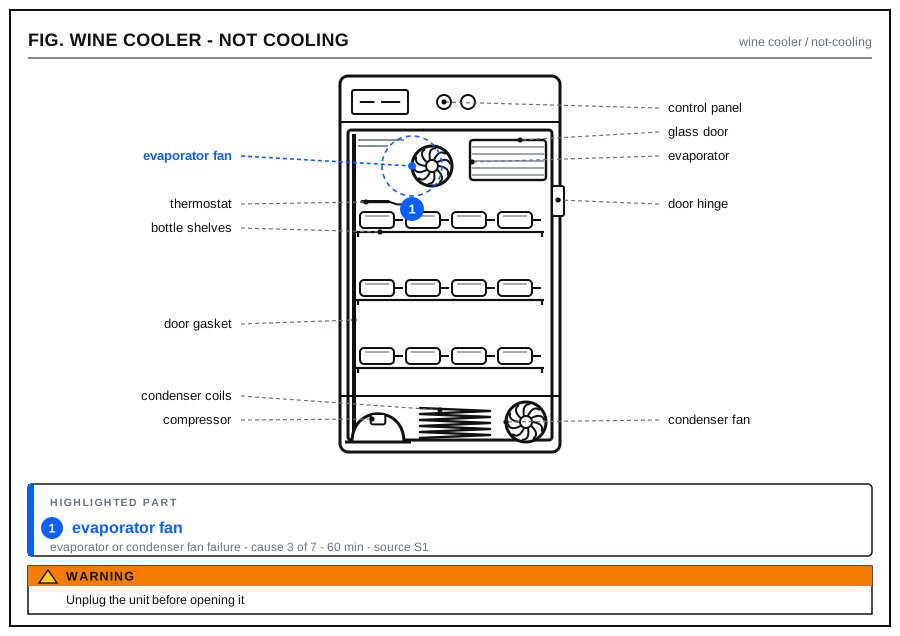
The source names the fans first and calls them the most common finding in the set behind this page: the evaporator fan inside the cabinet and the condenser fan behind it. Both are cheap parts, and a fan that has stopped shows up as a cabinet that runs continuously and still drifts warm, because the compressor is doing its job into air that is not moving. A wine cabinet usually stands in a quiet room, so a fan that has failed is easier to hear here than on a kitchen refrigerator. Time basis: no published duration, book estimate.
S1 publishes one band for the whole repair set rather than per-cause medians: a $368 median across 55 completed jobs with the middle half at $281-577, a $210 floor it attributes to a fan, a sensor or a control, and a $1,640 ceiling it attributes to sealed system work on a built in unit. No fan-specific figure is published, so none is claimed here.
the bottles feel warm and the display looks normalthe cabinet will not pull below sixty degrees
A wine cooler holds a much narrower temperature band than a kitchen refrigerator, around 55 degrees for long term storage, so a sensor that has drifted by a few degrees matters here in a way it would not elsewhere. The source's own caution is that the display can look normal while the cabinet is warm, and that a cabinet holding a steady 58 does less harm to the wine than one swinging between 50 and 65, because repeated expansion and contraction works past the cork. Time basis: no published duration, book estimate.
As with the fans, S1 publishes no per-cause median for a thermostat or a sensor; its only published anchors are the $368 set median with the middle half at $281-577, the $210 floor for a fan, a sensor or a control, and the $1,640 sealed-system ceiling.
the bottles feel warm and the display looks normalit runs all the time but the temperature keeps climbing
The source calls the board the expensive routine failure and the point at which the age of the unit starts to matter. It is where a diagnosis ends after the airflow, the fans and the sensors have all tested good, and it is the fault that turns the age of a freestanding cabinet from a detail into part of the decision. The same visit is when the door and hinge alignment is checked, because a board and a seal can both be marginal at once on an older glass fronted cabinet. Time basis: no published duration, book estimate.
S1 publishes no board-specific median; its published anchors are the $368 set median with the middle half at $281-577, the $210 floor it attributes to a fan, a sensor or a control, and the $1,640 sealed-system ceiling.
the compressor is warm and humming but nothing gets coldit runs all the time but the temperature keeps climbing
The top of the source's range, and the one fault on this page that needs refrigerant handling rather than a part swap. On a built in or undercounter cabinet it is still usually worth doing, and the source's own illustration is exactly that: even the largest repair in its set, at $1,640, was worth making because the alternative involved cabinetry. On an older freestanding cabinet this is where the money starts to point at replacement instead. Time basis: no published duration, book estimate.
S1 puts the dearest job in its set at $1,640 and attributes it to sealed system work on a built in cabinet; it publishes no separate compressor or refrigerant figure, so that ceiling is the only published anchor for this cause.
Repair or replace?
Start with the room and the venting, because the cited source finds more of these calls are about location than about mechanics and a cabinet doing what it was built to do needs no repair at all. If the machine is at fault, the split that decides the money is the fault class: fans, sensors, seals and boards are worth fixing on any cabinet that is not at the end of its life, while a sealed system failure on an older freestanding unit is where replacement starts to make more sense. A built in or undercounter cabinet reverses that last point, because replacing one means matching a cabinet opening and a vent and often accepting a visible mismatch. The one case where neither repair nor replacement of the same type solves anything is a thermoelectric cabinet in a room that runs hot: the answer there is a compressor unit. [S1]
One dataset sits behind every figure on this page: the cited source's 55 completed wine cooler repairs from its own service records. It publishes a single band for the whole set rather than per-cause medians, so the band above is that set's middle half, the median is $368, and the only cause-specific anchors it gives are the two ends - $210, which it attributes to a fan, a sensor or a control, and $1,640, which it attributes to sealed system work on a built in unit. No number on this page comes from a second dataset.
The comparison an owner wants is a repair against a new cabinet, and no source behind this page publishes a replacement price for a wine cooler, so no figure is claimed for one. What the source does publish is the shape of the call: its own dearest repair, $1,640 for sealed system work on a built in unit, was still worth making because replacing that cabinet meant matching a cutout and a vent, while for a freestanding cabinet its advice is to weigh the age of the unit against the fault. The contents are the other half of the arithmetic and the source is explicit that they are not covered by it: wine is degraded by repeated temperature swings, so a cabinet drifting warm is a reason to move the bottles before booking anything.
No source behind this page publishes an expected service life for a wine cooler, so the record states that instead of guessing a number. The decision here turns on the fault class and on how the cabinet is installed - built in, undercounter or freestanding - rather than on an age line, which is the split the cited source itself uses.
cabinet standing where the room, not the machine, sets the temperature [S1]
high likelihoodeasyno part neededabout 5 min
it runs all the time but the temperature keeps climbingthe cabinet will not pull below sixty degrees
The source's own headline finding, and the reason this page starts with a free check: more wine cooler calls than any other appliance it services turn out to be about location rather than mechanics. A cabinet in a garage or a sunroom faces ambient temperatures its rating never assumed, a built in unit whose front vent is blocked by a kick plate or a rug cannot reject heat, and a freestanding cabinet pushed tight against a wall has the same problem from behind. In each case the appliance is healthy and the installation is the fault, which is also the most common reason a replacement cabinet fails the same way inside a year. Time basis: no published duration, book estimate.
thermoelectric cabinet asked for more pull-down than its rating allows [S1]
high likelihoodeasyno part neededabout 10 min
the cabinet will not pull below sixty degreesit runs all the time but the temperature keeps climbing
A thermoelectric unit uses a solid state module rather than a compressor, and it can only pull the interior a fixed number of degrees below the room. In a hot kitchen in August one that cannot hold temperature may be working exactly as designed and simply be out of its depth, and the source says plainly that on a thermoelectric unit failing in a hot room there is often nothing to repair. Measuring the room as well as the cabinet is the test. The consequence for the decision is the sharpest statement on this page: replacing a thermoelectric cabinet with another thermoelectric cabinet in the same hot room solves nothing, and the answer is a compressor unit. Time basis: no published duration, book estimate.
condensation is running down the inside of the glassthe cabinet will not pull below sixty degrees
Glass doors are heavy, and the source's point is that a hinge which has dropped over a few years stops the seal meeting the cabinet evenly, so the cabinet loses cold air at the door without anything inside it having failed. The tell is condensation, and the useful distinction is which side of the glass it is on: on the outside it is room humidity meeting a cold surface and is not a fault at all, while condensation inside the cabinet points at the seal or the hinge. Wine cabinets add this check that a refrigerator does not need, because the glass door is the whole front of the machine. Time basis: no published duration, book estimate.
S1 publishes no per-cause figure for a seal or a hinge either; its published anchors stay the $368 set median with the middle half at $281-577, the $210 floor and the $1,640 sealed-system ceiling.
What each fix costs
Cause
Cost
Time
DIY?
cabinet standing where the room, not the machine, sets the temperature
no part needed
5 min
easy
thermoelectric cabinet asked for more pull-down than its rating allows
no part needed
10 min
easy
evaporator or condenser fan failure
not priced
60 min
moderate
thermostat or temperature sensor drift
not priced
45 min
moderate
door seal or dropped hinge out of alignment
not priced
30 min
easy
control board failure
not priced
60 min
advanced
sealed system failure
$1,640 installed
240 min
pro
A technician visit starts with a diagnostic fee of $99 [S1]. Completed repairs run $281–$577 [S1].
Sources
[S1]Bozmanfix (medians of 55 completed wine cooler repairs from its own service records across six states; page published 7 September 2026) (2026-09-07). the $368 median across 55 completed wine cooler repairs with the middle half at $281-577, the $210 cheapest job in the set (attributed to a fan, a sensor or a control) and the $1,640 dearest (sealed system work on a built in unit), the $99 service call applied to the repair when it is approved, the invoice floor of $200 above which a part was fitted, the two cooling technologies (thermoelectric units that pull a fixed number of degrees below room temperature against compressor units that hold temperature regardless of the room), the failure list (evaporator and condenser fans, thermostats and sensors, door seals and hinges, control boards, the sealed system), the location finding that more of these calls are about installation than mechanics (garage and sunroom ambient, a blocked front vent on a built in, a freestanding cabinet against a wall), the three complaints that are not faults (condensation on the outside of the glass, a compressor hum, a few degrees between the top and bottom shelves), the storage targets (around 55 degrees, stability ahead of the exact figure, humidity between 50 and 70 percent, darkness and stillness), and the repair-or-replace split (built in and undercounter cabinets almost always repaired because replacement drags cabinetry in, freestanding cabinets decided on age and fault, thermoelectric cabinets in hot rooms fixed by neither)
Last verified: 2026-09-19. Prices are US market figures from the sources above; your quote may differ.
Built from a fact record, not from a template: every number above is tied to one of the sources and the record is re-checked against them. Editorial choices (which symptom leads, which cause is the single tell) are kept in a separate block so the facts stay auditable.
Quick answers
How much does it cost to fix a wine cooler with this problem?
Completed repairs run $281–$577 according to the sources cited on this page, after a diagnostic fee of $99.
How long does a wine cooler last?
No source cited on this page publishes an expected life for the machine itself, so the page says so rather than guessing; the decision here turns on the fault and on how the unit is built and installed, not on an age line.
Repair or replace?
Start with the room and the venting, because the cited source finds more of these calls are about location than about mechanics and a cabinet doing what it was built to do needs no repair at all. If the machine is at fault, the split that decides the money is the fault class: fans, sensors, seals and boards are worth fixing on any cabinet that is not at the end of its life, while a sealed system failure on an older freestanding unit is where replacement starts to make more sense. A built in or undercounter cabinet reverses that last point, because replacing one means matching a cabinet opening and a vent and often accepting a visible mismatch. The one case where neither repair nor replacement of the same type solves anything is a thermoelectric cabinet in a room that runs hot: the answer there is a compressor unit.