Skip to contentRepaplexrepair or replace, decided by the numbersAutomatic follows the operating system setting. Light and dark override it and are remembered in this browser.
cooktop: a cooktop zone that has stopped heating while the surface is intact
A cooktop zone that stops heating while the surface is intact is not a glass problem at all: on a radiant top it is usually the element or the switch feeding it, and on an induction top it is electronics rather than a consumable. The visit is what the invoice is made of, which is why the expensive mistake here is replacing the wrong thing. The visit is what the money goes on here: $99 [S1] covers the diagnostic alone, and every one of the 4 causes on this page needs a part. The complaint is a cooktop zone that has stopped heating while the surface is intact, described as one zone on the cooktop stopped heating, a burner ring never gets hot while the others work, the zone heats and then drops out mid-boil, the surface is intact but one area stays cold or the cooktop clicks or lights up but nothing heats. A radiant element that has failed open-circuit in the dead zone is where to start — $380 installed, about 60 minutes [S1].
What the fault looks like
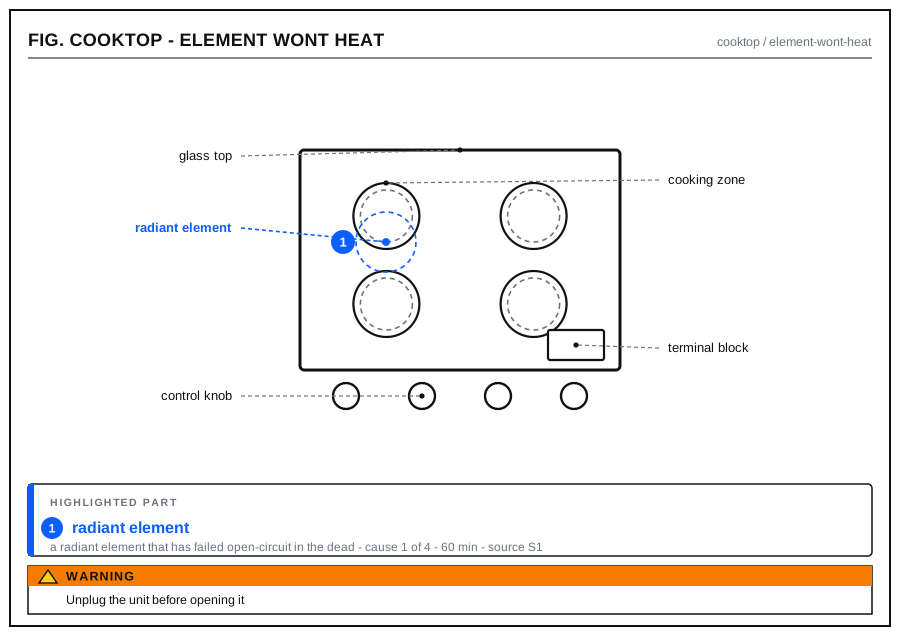
Fig. COOKTOP - ELEMENT WONT HEAT
What a technician actually does
a radiant element that has failed open-circuit in the dead zone [S1]
high likelihoodadvanced$380 installedabout 60 minn=17 completed jobs[S1]
one zone on the cooktop stopped heatingthe surface is intact but one area stays cold
The single most common complaint in this publisher's cooktop records, and the one the second source describes from the other side: a zone that stops heating while the surface is intact is not a glass problem at all, and the first thing to suspect under the surface is the element itself. It is priced as a completed job at a $380 median across 17 jobs, inside a slice whose middle half runs $321-440. The second source's framing is worth keeping: this is the cheapest scenario on the machine, because the intact surface stays in place and nothing has to be bonded or sealed. Expect the appliance to come forward out of the counter rather than the surface to come off, and expect the labour rather than the element to dominate the invoice.
the element is published as a completed job - part, labour and the service call together - so the installed figure below is the median invoice, not the price of the element. The source's own note is that the distance between its cheapest and dearest routine repair is $9 because the visit and the labour do not change, which is the reason a part-only price would mislead here.
a failed zone switch or infinite switch behind the control [S1]
medium likelihoodadvancednot pricedabout 60 min
the zone heats and then drops out mid-boilone zone on the cooktop stopped heating
The other half of the source's own answer to a dead zone, stated almost as a rule: a dead zone on a radiant top is usually the element or its switch, not the glass, even when the glass looks marked. That distinction is what this page exists to make, because the two repairs are an order of magnitude apart in the customer's mind and much closer in reality. The switch is the part that modulates power to the zone, and a switch that has failed closed, failed open or gone intermittent produces exactly the same symptom as a dead element from the front of the machine - which is why the source's advice is to test before quoting rather than to replace the visible suspect.
no source behind this page publishes a price for the switch on its own, and the first source's part table covers a gas burner and an igniter rather than the switch that feeds an electric zone. The price therefore sits inside the completed-job band above rather than on a part line, and nothing is claimed for the component.
a loose or burnt connection where the element plugs into its receptacle [S2]
medium likelihoodmoderatenot pricedabout 45 min
the zone heats and then drops out mid-boilthe cooktop clicks or lights up but nothing heats
The intermittent version, and the one the source calls a cheap fault wearing an expensive costume: a cooktop that works intermittently, or where one zone drops out and comes back, is more often a connection or a switch than the expensive component it appears to be. The second source names the same item from its own side of the machine - a burned wiring connection under an intact surface is one of the three things a zone that stopped heating usually turns out to be. A terminal that has been arcing is also the reason a dead zone should not simply be switched back on and watched: heat at a loose connection is a fire risk before it is a fault.
no part-only price is published for this because on most machines the repair is a connection rather than a component: the element lifts out of its receptacle and the terminal is cleaned, re-tensioned or replaced. The second source lists the same possibility as burned wiring under the surface, which is a labour fix inside the band above.
on an induction top, a coil or the board driving it rather than an element [S1]
medium likelihoodpronot pricedabout 120 min
the surface is intact but one area stays coldone zone on the cooktop stopped heating
The one version of this symptom that is not an element, and the one worth knowing before a quote is accepted. The source's own description is that induction behaves like a different category: there are no heating elements at all, only coils and the boards driving them, and when an induction top fails it is almost always electronic - which puts it at the top of the range and makes it the one type where the repair-or-replace question comes up on a relatively young appliance. A zone that has stopped on an induction surface therefore points at electronics rather than at a consumable, and the honest first step is the same one the source uses everywhere on this machine: test the zone before quoting, because the expensive component is not always the failed one.
induction parts are not on the first source's part table at all, and the second source prices induction only as a national installed range rather than as its own completed jobs. Nothing is claimed for the coil or the board, and the decision arithmetic below uses the completed-job band instead.
Repair or replace?
Treat a dead zone as a diagnosis rather than a part, because the source says plainly that a zone which stops heating on a radiant surface is usually the element or its switch and not the glass, even when the glass looks marked, and that an intermittent zone is more often a connection or a switch than the expensive component. Write down which zone and when: a ring that never heats points at an open element, one that heats and then drops out mid-boil points at a switch or a connection, and a zone that stopped on an induction surface points at electronics rather than at a consumable. Do not judge the surface by eye - the second source's whole page exists because most people assume the glass is the problem while the intact surface keeps working. Have the zone metered before anything is ordered, since the element, the switch and the terminal all present identically from the front of the machine; if the diagnosis finds failed elements or a failing board underneath a damaged surface, that is the point at which the source itself says to shop for a new machine with both figures in front of you, and you pay only the $99 diagnostic. [S1]
Two slices of the same publisher's cooktop records stand behind this page and each figure names its own. The band and the count come from the cost slice: 317 completed cooktop repairs with an overall median of $375 and a middle half of $295-487, in which the row element will not heat runs a $380 median with the middle half at $321-440 across 17 jobs, and the row cracked glass runs $644 with a middle half of $380-764. The second slice is the 122-repair set behind the glass-replacement guide, where the publisher reports a $339 median with a middle half of $255-530 for all completed cooktop repairs - the same page also prints $338 in one of its answers, and both are quoted here rather than reconciled, because the source does not reconcile them - and a separate count of 215 completed cooktop diagnostics of which 56.7% ended with the part fitted and the machine working. The two slices overlap in the publisher's records and are not added together. The replacement figure is the appliance value the second source uses in its own decision framework, not a price list.
This is the cheapest version of a cooktop decision, and the source gives the arithmetic from both ends. A zone that has stopped heating with the surface intact runs a $380 median across 17 completed jobs, inside a symptom band of $321-440 and an overall cooktop band of $295-487, against an appliance the same publisher values at $700-2,000 - so on any machine that is mid-range or better and under about ten years old the repair is not a close call. The publisher's own approval rate makes the same point from the business side: across 215 completed cooktop diagnostics, 56.7% ended with the part fitted and the machine working again. The one case where the arithmetic turns is the one the source names: an entry-level unit near the end of its life, or a diagnosis that finds a failed element and a failing board at the same time, stacking two repairs into one bill - and on a discontinued model the availability of the part, rather than its price, is what decides it.
S2's own decision framework is age-based rather than table-based: replacing a part makes clear sense when the appliance is mid-range or better, less than about ten years old and everything under the surface still works, because it restores a $700-2,000 appliance for a fraction of that; it stops making sense on an entry-level unit near the end of its life, or when the diagnosis finds failed elements or a failing board underneath. The planning life used here is the cooking-appliance convention already carried by this site's other cooktop page rather than a new estimate
a failed zone switch or infinite switch behind the control
not priced
60 min
advanced
a loose or burnt connection where the element plugs into its receptacle
not priced
45 min
moderate
on an induction top, a coil or the board driving it rather than an element
not priced
120 min
pro
a radiant element that has failed open-circuit in the dead zone
$380 installed
60 min
advanced
A technician visit starts with a diagnostic fee of $99 [S1]. Completed repairs run $321–$440 [S1].
Sources
[S1]Bozmanfix (completed cooktop jobs, published 6 September 2026) (2026-09). the 317 completed cooktop repairs and the publisher's note that thin cuts were left out rather than stated; the $375 median with the middle half at $295-487; the element-will-not-heat row at a $380 median with the middle half at $321-440 across 17 jobs; the cracked-glass row at $644 with a middle half of $380-764; 79 burner repairs at a $381 median with a middle half of $309-482; an igniter at $390 with a middle half of $320-480; the brand medians from $320 to $416; the range of the whole set from $203 to $1,485; the $99 diagnostic credited against the repair; the note that the visit and the labour do not change between parts, so the $9 gap between the two routine repairs is not a parts gap; and the three appliance types - gas faults usually mechanical and cheap, a radiant top where a dead zone is usually the element or its switch and an intermittent zone is more often a connection than the expensive component, and induction, which has no heating elements at all - only coils and the boards driving them - and fails electronically at the top of the range
[S2]Bozmanfix (completed cooktop jobs and diagnostics, published 23 August 2026) (2026-08). the 122 completed cooktop repairs, their $339 median with the middle half at $255-530, and the same page's $338 figure in one of its answers; the note that the median covers all completed cooktop repairs including element and wiring fixes, with glass assembly work sitting toward the upper half of the band because the part is the expensive half of the invoice; the 215 completed cooktop diagnostics of which 56.7% ended with the part fitted and the machine working again; the decision framework in which replacement makes clear sense on a mid-range or better appliance under about ten years old with everything under the surface working - restoring a $700-2,000 appliance for a fraction of that - and stops making sense on an entry-level unit near the end of its life or when the diagnosis finds failed elements or a failing board beneath the surface, in which case the customer pays only the $99 diagnostic; and the finding that a zone which stopped heating with the glass intact is a failed radiant element, a burned wiring connection or a control board fault under the surface rather than a glass problem
Last verified: 2026-09-19. Prices are US market figures from the sources above; your quote may differ.
Built from a fact record, not from a template: every number above is tied to one of the sources and the record is re-checked against them. Editorial choices (which symptom leads, which cause is the single tell) are kept in a separate block so the facts stay auditable.
Quick answers
How much does it cost to fix a cooktop with this problem?
Completed repairs run $321–$440 according to the sources cited on this page, after a diagnostic fee of $99.
How long does a cooktop last?
The decision rule used on this page works from a planning life of 13 years.
Repair or replace?
Treat a dead zone as a diagnosis rather than a part, because the source says plainly that a zone which stops heating on a radiant surface is usually the element or its switch and not the glass, even when the glass looks marked, and that an intermittent zone is more often a connection or a switch than the expensive component. Write down which zone and when: a ring that never heats points at an open element, one that heats and then drops out mid-boil points at a switch or a connection, and a zone that stopped on an induction surface points at electronics rather than at a consumable. Do not judge the surface by eye - the second source's whole page exists because most people assume the glass is the problem while the intact surface keeps working. Have the zone metered before anything is ordered, since the element, the switch and the terminal all present identically from the front of the machine; if the diagnosis finds failed elements or a failing board underneath a damaged surface, that is the point at which the source itself says to shop for a new machine with both figures in front of you, and you pay only the $99 diagnostic.