Automatic follows the operating system setting. Light and dark override it and are remembered in this browser.
Symptom guide / oven
The oven cooks unevenly or at the wrong temperature
This is the one oven fault a household can settle with a $15 thermometer and a five-minute adjustment: the source's own thresholds are a 10-15 degree tolerance, 25 degrees for recalibration and 50 for a failed part. Calibration drift, which is not a failed part: 10 minutes, no part needed [S1] — the first of 1 causes on this page that need no part at all. On a oven the complaint is the oven cooks unevenly or at the wrong temperature, and it arrives in these words: cookies spread thin and burn at the edges, cakes stay dense and will not rise, roasts finish well before the recipe time, one tray bakes fine and the other burns or everything suddenly takes much longer than it used to. Until that check comes back clean, every price below is premature — the completed repairs behind this symptom run $319–$469 [S2], against a replacement from $700.
372 of the 1,713 completed jobs in that dataset [S2] sit behind the counts above. Each figure is the source's own median invoice - parts, labour and the service call together, never the part alone.
medium likelihoodadvanced$420 installedabout 60 minn=19 completed jobs[S2]
everything suddenly takes much longer than it used toroasts finish well before the recipe time
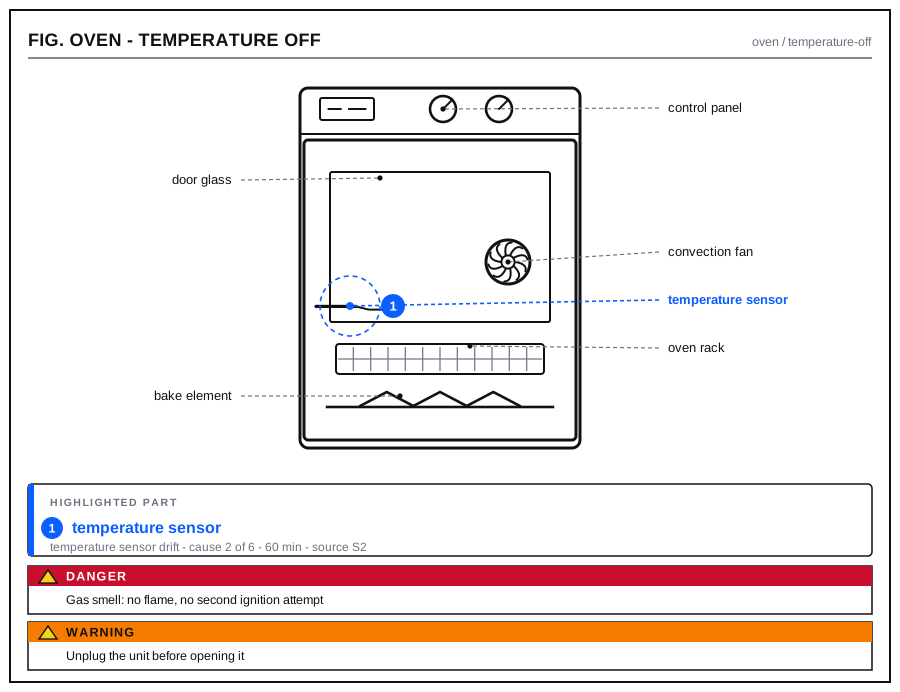
The first of the two things calibration cannot fix, and the harder one to see because it fails gradually. A sensor that has drifted reports a temperature that is close enough to look plausible, so the oven cycles on and off more often than it used to and preheating takes longer than it did. S1 puts it in the same bucket as a mechanically failed sensor; S2 prices the repair at $420, which is the second most expensive of the three branches its diagnostic separates.
S2 prices a completed thermostat or temperature sensor replacement at $420 across 19 jobs; no part-only price is published
medium likelihoodmoderate$319–$322 installedabout 60 minn=57 completed jobs[S2]
cakes stay dense and will not riseone tray bakes fine and the other burns
An element does not usually fail outright - it weakens, so the oven still reaches temperature but takes longer to get there and recovers slowly after the door opens. That is what makes it look like a calibration problem to a cook and like a sensor problem to a thermometer. S1 lists worn heating elements alongside sensor faults for exactly this reason; the tell is whether the error is consistent across the whole range or only shows up once the oven is loaded. This count is S2's completed-job row; S1 stands as the diagnosis source, not as the source of the number.
S2 prices a completed heating element replacement at $319 across 57 jobs and a bake element at $322 across 18, so the two are the same repair by price; no part-only figure is published
gas igniter degrading, so the oven heats weakly [S2]
medium likelihoodpro$350 installedabout 75 minn=209 completed jobs[S2]
everything suddenly takes much longer than it used tocakes stay dense and will not rise
The most replaced component in the source's entire dataset - 209 completed jobs, more than any other part on any appliance it services - and the reason a gas oven bakes unevenly before it stops working: an igniter that has weakened still lights the burner, but it takes longer to do it, so the oven runs behind its own thermostat. Nothing about this is a DIY job. The source's blunt summary of the price is the useful part: a $30 part becomes a $350 invoice, and the part price is never the quote.
S2 prices a completed gas igniter replacement at $350 across 209 jobs, and states that an igniter retailing around $30 arrives at $350 on the invoice once the visit, the gas-safe removal and reinstallation and the warranty are counted
failed control board deciding the wrong thing [S2]
everything suddenly takes much longer than it used toone tray bakes fine and the other burns
The third branch, and the one that makes the source's diagnostic worth paying for: a heat source, a sensor and a board produce an identical complaint from the customer's side, and they are priced $319-350, $420 and $469. The source is explicit that this is the question a visit answers on an oven - is it the thing that makes the heat, the thing that measures it, or the thing that decides when to apply it.
S2 prices a completed control board replacement at $469 across 87 jobs, the dearest of the three branches its diagnostic separates; no part-only figure is published
uneven heat that is not a temperature error at all [S1]
medium likelihoodmoderate$319–$322 installedabout 60 min
one tray bakes fine and the other burns
The variant the source pulls out of the calibration list deliberately: a tray that bakes perfectly next to one that burns is not an oven lying about its temperature, it is heat reaching the two trays differently. Recalibrating that oven moves both trays in the same direction and fixes nothing, which is the most common way a household spends an afternoon on the wrong problem.
no separate figure is published for this; it resolves to the element or fan repair S2 prices at $319-322, or to convection hardware the source does not price
Repair or replace?
The verdict
Measure before anything is priced: a thermometer at 350F separates a 10-15 degree tolerance from a 25 degree calibration error and from a 50 degree failed part, and the first is free to fix. If the error survives calibration, the repair is one of three things at $319-350, $420 or $469, and the source's own numbers say the cheap end is by far the most common - the heating element and the gas igniter together account for 284 of the 390 priced jobs in its table. Recalibrating an oven with an uneven tray problem fixes nothing, so that variant goes straight to a diagnosis. [S2]
all oven repairs, on the publisher's calibration page, from a second published dataset: $349 median, middle half $260–$468 [S1] — n=2664 completed jobs[S1]
Four of the six causes on this page carry a published job count, all four from the same publisher's oven repair cost table: temperature sensor or thermostat 19, heating element 57, gas igniter 209, control board 87. The two that do not are calibration drift and uneven heat, and the source is emphatic about why: it publishes no calibration figure because across its own records there is effectively no such repair, and an oven running at the wrong temperature either gets a part replaced or nothing is done, while uneven heat is diagnosed rather than replaced and the source gives it no row. Two of the six causes therefore stand without a denominator (uneven heat, calibration drift), stated rather than given a number. The record-level denominator is bound by name to the dataset the counted causes come from, the 1,713-job oven and range table. The 372 those four rows add up to is a subset of the 1,713 and is never a total, and no second denominator is claimed on this page. The publisher's own calibration page prints a second, larger oven sample of its own: a $349 median across 2,664 completed oven repairs, with the middle half between $260 and $468. That row is carried above as its own labelled band, and it is a different published sample from the 1,713-job table the counted causes come from - the same publisher's two oven pages, two denominators, never added together and never averaged.
The comparison is not the repair against a new oven, it is the repair against the diagnostic: a $99 visit applied to a $319-469 repair is money spent once, while calibrating a failing sensor or element costs nothing and leaves the fault in place. On a built-in wall oven the replacement comparison does not start until the repair passes roughly half of a $700-1,500 unit, which the upper end of the board repair approaches - and only on a machine already past its service life.
the 15-year oven line used across this site's oven guides, combined with S2's own framing that an oven sits in the middle of the appliances it services - about $47 above a dishwasher and $16 below a refrigerator - so a $319-469 repair on a built-in unit is rarely the moment to replace it
Have a quote?
Put your quote and the age of the unit into the calculator — the same half-of-new-price rule, with your own numbers.
calibration drift, which is not a failed part [S1]
high likelihoodeasyno part neededabout 10 min
cookies spread thin and burn at the edgescakes stay dense and will not riseroasts finish well before the recipe time
The source's whole method is built around one cheap measurement: a $15 oven thermometer at 350F, read after the oven has settled. A gap of 10-15 degrees is normal; 25 degrees or more means recalibrate, and a digital oven lets you dial a calibration offset in under five minutes. Dial-control ovens adjust with a screwdriver behind the knob instead. The distinction that matters is in the record's fourth variant: a result that changed suddenly rather than gradually is a failing part, not drift, and recalibrating it only hides the symptom. The adjustment itself costs nothing.
What each fix costs
Cause
Cost
Time
DIY?
calibration drift, which is not a failed part
no part needed
10 min
easy
worn heating element, or a weak bake element
$319–$322 installed
60 min
moderate
uneven heat that is not a temperature error at all
$319–$322 installed
60 min
moderate
gas igniter degrading, so the oven heats weakly
$350 installed
75 min
pro
temperature sensor drift
$420 installed
60 min
advanced
failed control board deciding the wrong thing
$469 installed
90 min
pro
A technician visit starts with a diagnostic fee of $99–$150 [S2]. Completed repairs run $319–$469 [S2].
Sources
[S1]Bozmanfix (field guide; page updated 2026) (2026-09). the thermometer method and its thresholds (a $15 thermometer at 350F, 10-15 degrees normal, 25 or more to recalibrate, 50 or more indicating a failed part), the digital calibration offset and the screwdriver adjustment behind a dial, the food-to-behaviour table (spread cookies running hot, dense cakes running cold, thick dark crust from too much top heat, a roast finishing early, one tray burning while another bakes, and a sudden change meaning a failing part), the more frequent cycling and longer preheating as thermostat symptoms, and the four failure groups it names (sensor drift, sensor mechanical failure, worn heating elements, gas oven failure points), plus its own FAQ figure for all oven repairs - a $349 median with the middle half at $260-468 across 2,664 completed oven repairs
[S2]Bozmanfix (medians from 1,713 completed oven and range repairs; page published September 2026) (2026). the $375 median with the middle half at $302-478 across 1,713 jobs; oven and range repair prices with the job count beside each row: heating element $319 n=57, bake element $322 n=18, gas igniter $350 n=209, thermostat or temperature sensor $420 n=19, control board $469 n=87; part-level cells with fewer than ten completed jobs are not published; the $99 diagnostic ($150 on a double wall oven) and its three-branch question (heat source, sensor, board); the $30 igniter becoming a $350 invoice; the wide upper quartile explained by built-in and pro-style units; and the comparison of an oven to a dishwasher and a refrigerator. Its own Repair or Replace section publishes the replacement side of the arithmetic: a new freestanding range runs roughly $700 to $1,500 before delivery and installation, a built-in wall oven runs well past that because replacement means matching a cabinet cutout, and a pro-style replacement is several thousand - the section prices an igniter or element at $319-350 against a 1,000 dollar range and calls it not a close call, so the $700-1,500 figure is the source's own published new-unit band for a freestanding range
Last verified: 2026-09-29. Prices are US market figures from the sources above; your quote may differ.
Built from a fact record, not from a template: every number above is tied to one of the sources and the record is re-checked against them. Editorial choices (which symptom leads, which cause is the single tell) are kept in a separate block so the facts stay auditable.
Quick answers
How much does it cost to fix a oven with this problem?
Completed repairs run $319–$469 according to the sources cited on this page, after a diagnostic fee of $99–$150.
How long does a oven last?
The decision rule used on this page works from a planning life of 15 years.
Repair or replace?
Measure before anything is priced: a thermometer at 350F separates a 10-15 degree tolerance from a 25 degree calibration error and from a 50 degree failed part, and the first is free to fix. If the error survives calibration, the repair is one of three things at $319-350, $420 or $469, and the source's own numbers say the cheap end is by far the most common - the heating element and the gas igniter together account for 284 of the 390 priced jobs in its table. Recalibrating an oven with an uneven tray problem fixes nothing, so that variant goes straight to a diagnosis.