Skip to contentRepaplexrepair or replace, decided by the numbersAutomatic follows the operating system setting. Light and dark override it and are remembered in this browser.
washing machine: a washing machine whose door is still locked after the cycle ends
A washer that will not let you in is usually reporting the door rather than failing at it. The manufacturer's own definition of the door code lists an incompletely closed door as a cause, and the cheapest version of this symptom is a sock sitting in the boot seal where the latch has to reach. Most of the bill on a washing machine is access labour rather than parts — the diagnostic alone runs $99 [S1], and the cheapest item on the list needs no part at all [S2]. The complaint — a washing machine whose door is still locked after the cycle ends — narrows to a handful of causes, and whether the machine has to come apart separates them. It arrives in these words: the door stays locked after the cycle ends, the washer will not unlock and there is still water in the drum, the display shows a door error and the latch never releases, the door had to be forced open after waiting an hour or the lock clicks but the door will not open. Start with an item caught in the boot seal holding the latch open — no part needed, about 5 minutes [S2].
What the fault looks like
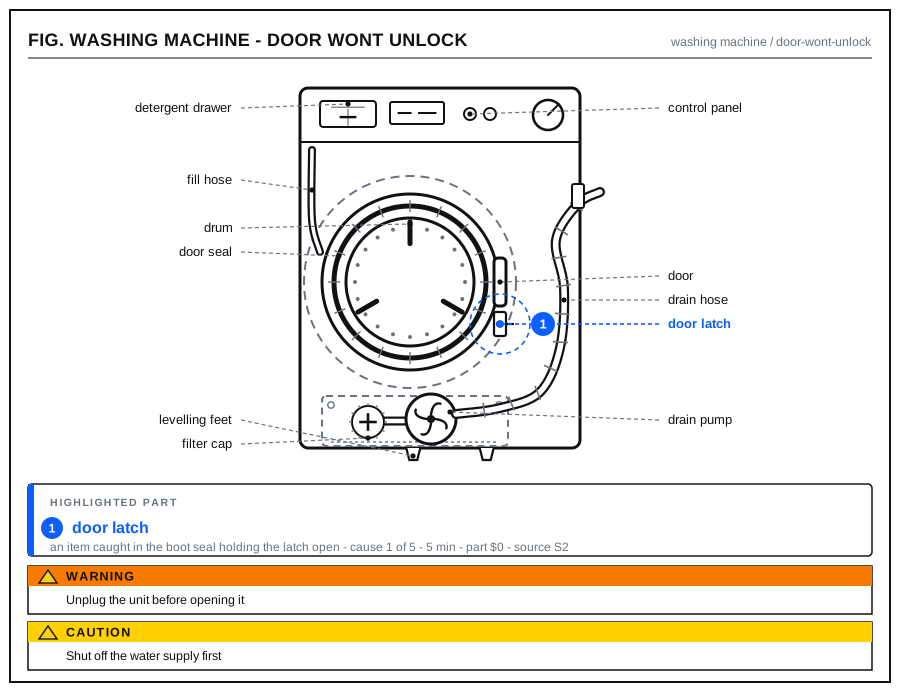
Fig. WASHING MACHINE - DOOR WONT UNLOCK
What the dE code on a washing machine means
dE (also shown as dE1, dE2) — the washer is unable to lock its door, with an incompletely closed door listed by the manufacturer as a cause [S2].
Do this first (free)
an item caught in the boot seal holding the latch open [S2]
high likelihoodeasyno part neededabout 5 min
the door stays locked after the cycle endsthe lock clicks but the door will not opendE
The source's own first answer, and the reason a door error is not automatically a failed lock: the manufacturer defines the door code as the machine being unable to lock its door and lists an incompletely closed door as a cause, and the page adds the case a household can actually find - a single sock caught in the boot seal will stop the latch engaging, and the machine reports a lock fault rather than an obstruction. Run a finger around the inside of the rubber boot, pull the lip of the seal back and look at the strike plate the latch has to reach; a coin, a sock or a hardened lump of detergent in that fold produces exactly this symptom with nothing broken. Nothing to buy.
a control lock or another setting the machine is holding [S2]
medium likelihoodeasyno part neededabout 2 min
the lock clicks but the door will not openthe display shows a door error and the latch never releasesdE
The source opens by dividing its own codes into two groups, and this is the first group: the codes that describe the load, a setting or the power supply rather than a failed part, and it names the door-lock family letter group the same way. A control lock, or a panel left in a mode the household did not know was on, holds the latch closed on purpose and cancels the moment the lock is released. The source's own instruction for the lock family is to hold the lock or the door-release button for about three seconds and watch the panel rather than the door. Free.
a latch held by a control glitch rather than a failed part [S2]
medium likelihoodeasyno part neededabout 10 min
the door stays locked after the cycle endsthe door had to be forced open after waiting an hourdE
The source documents the reset as a built-in procedure rather than folklore: press power to switch the machine off, unplug it or switch off its breaker, wait about a minute, restore power and switch it back on, which clears codes caused by a momentary glitch rather than a failure. It is worth doing once here, because a latch that has not been told to release is the cheapest version of this symptom. The same page is equally clear about the limit: what a reset does not do is fix a blocked drain, a failed latch or a dead valve, and if the same code returns within a cycle or two the machine is reporting something real. Free.
high likelihoodadvanced$390 installedabout 60 minn=14 completed jobs[S2]
the display shows a door error and the latch never releasesthe lock clicks but the door will not opendE
The part behind the code, once the three free checks are clear. The source prices it from the other direction: the door-lock median is $390, taken from the 14 completed jobs in which the door latch was the part fitted, and it is quoted across all washer brands rather than LG alone. A separate brand dataset on the same publisher measures the same part at $385 with the middle half of jobs at $317-519 across 24 completed GE door latch or lid lock repairs (S4, which prints a row only above fifteen completed repairs), and the GE complaint row for a door, lid or latch fault runs a $370 median across 270 visits. Those three figures are three samples and are never added together. Expect access labour rather than part cost: on most front loaders the latch sits behind the door seal and its spring band, and the front panel carries the lock and its wiring.
no source behind this record publishes a part-only price for the latch. The figures are completed jobs - part, labour and the service call together - so an installed figure is claimed below and nothing is claimed for the component on its own.
a control board that never releases the latch [S2]
medium likelihoodpro$439 installedabout 90 minn=112 completed jobs[S2]
the door stays locked after the cycle endsthe display shows a door error and the latch never releases
The expensive version of the same symptom, and the one the source explicitly warns about: a failed latch is frequently confused with a control board at $439 because both present as a machine that will not behave, and the board figure rests on 112 completed jobs. The reason it matters here is the order of the two prices - $390 for the latch against $439 for the board is close enough that guessing is expensive, and the two are separated with a meter at the latch connector rather than by the symptom. Before a board is condemned, the connector it reads through and the load it drives should have been checked; that is the same caution the publisher prints on its brand pages, where it warns that a board is the easiest thing to reach for when a fault is intermittent.
the board is published as a completed job rather than as a bare part, so the installed figure below is the median invoice and no part-only price is claimed.
What each fix costs
Cause
Cost
Time
DIY?
an item caught in the boot seal holding the latch open
no part needed
5 min
easy
a control lock or another setting the machine is holding
no part needed
2 min
easy
a latch held by a control glitch rather than a failed part
no part needed
10 min
easy
a failed door lock assembly
$390 installed
60 min
advanced
a control board that never releases the latch
$439 installed
90 min
pro
A technician visit starts with a diagnostic fee of $99 [S1]. Completed repairs run $350–$440 [S1].
Repair or replace?
Do the free three before anything is ordered, in this order: run a finger around the inside of the door boot and look at the strike plate the latch reaches, because a sock or a coin in that fold holds the latch open and the machine reports a door fault rather than an obstruction; hold the lock or door-release button for about three seconds in case a control lock is holding the door closed; and then do the reset the manufacturer builds in - power off, unplug or trip the breaker, wait about a minute, restore power. If the door releases, nothing was broken. If the same fault returns within a cycle or two, the reset has done its job as a test and the remaining question is which of two parts it is: the latch at $390 across 14 completed jobs, or the board at $439 across 112, which the source says are routinely confused with each other. Have the latch connector metered rather than replacing either on suspicion, and if the drum still holds water, the door is being kept shut by the machine rather than by a fault in the lock - drain it through the filter access first, because that is a different repair on the same machine. [S1]
Three slices of the same publisher's washer records sit behind this page and each figure below names its own. The band and the record-level median come from the 492 completed washer repairs in which the customer reported an error code (median $385, and the publisher's own summary that most coded washer repairs land between $350 and $440). The code and the latch price come from the brand code page: dE is the door error, and the door-lock component median is $390 across the 14 completed jobs in which that part was fitted, in a 744-job LG washer code-frequency set where LG washer work as a whole runs a $385 median with the middle half at $319-461 across 312 completed repairs. The independent brand slice is GE: 270 visits for a door, lid or latch complaint at a $370 median, and 24 completed door latch or lid lock repairs at $385 with a middle half of $317-519. No figure from one slice is added to a figure from another, and no sum of the causes is printed, because the same visit can end at more than one of them.
The arithmetic here is unusually easy and unusually easy to get wrong in the other direction. A latch at a $390 median across 14 completed jobs, or a board at $439 across 112, against a replacement band starting at $700, both sit comfortably on the repair side on a machine with years left in it. What makes it worth saying out loud is how often this particular repair is refused: on the same publisher's GE records, dryer repairs are approved 79.0% of the time and washer repairs only 57.4%, even though the washer repair is only $56 dearer at $376 against $320 - the publisher's own explanation is not the price but that a washer is the easiest major appliance in the house to replace. A door that will not open is not a reason to replace a machine, but it is the fault most likely to end that way, so the two prices are worth having in front of you before the decision is made.
the replacement band and the planning life are the same FlexFul figures used across this site's washing machine pages - a new machine at $700-1,100 against a planning life of about eleven years - and they are the only figures on this page that do not come from a repair job record
[S1]Bozmanfix (completed washer jobs, published 23 August 2026) (2026-08). the 492 completed washer repairs in which the customer reported an error code and their $385 median; the publisher's statement that most coded washer repairs land between $350 and $440; the five code families (fill, drain, balance, door lock, motor and board) and the door and lid lock family ending at the door lock or lid switch at a $351 median; the all-4,763-repair washer median of $370 with the middle half at $310-445; the component medians as complete invoices - door lock $351, inlet valve $362, suspension $367, drain pump $381, drive motor $387, control board $436; the $99 diagnostic applied to the repair; the warning that a code names the subsystem that failed a check rather than the component that caused it
[S2]Bozmanfix (LG code meanings from the manufacturer's support library, prices from completed jobs) (2026-09). the manufacturer's definitions - dE, dE1 and dE2 as the washer being unable to lock its door with an incompletely closed door listed as a cause, and the page's own note that a single sock caught in the boot seal will stop the latch engaging and the machine reports a lock fault rather than an obstruction; the codes the manufacturer classes as describing the load, a setting or the power supply rather than a part; the per-code median for the drain code, $412 across 15 completed jobs, described as the only code with enough repairs behind it to publish its own median; the component medians across all washer brands - door lock $390 across 14 jobs, water inlet valve $362 across 104, drive motor $384 across 23, control board $439 across 112; the note that a failed latch is frequently confused with a control board; the reset procedure (power off, unplug or trip the breaker for about a minute) and its limit, that it will not fix a blocked drain, a failed latch or a dead valve; the 744 completed LG washer jobs behind the code-frequency table; the $385 median across 312 completed LG washer repairs with the middle half at $319-461; the $99 diagnostic credited against the repair
[S3]FlexFul Appliance Repair (Chicagoland) (2026). the replacement band for a new washing machine used in the decision arithmetic ($700-1,100) and the planning life of about eleven years, both consistent with the other washing machine pages on this site
[S4]Bozmanfix (GE service visits and completed repairs through August 2026) (2026-09). the GE door, lid or latch complaint row at a $370 median across 270 visits (5.4% of GE work), the door latch or lid lock component row at $385 with the middle half at $317-519 across 24 completed repairs (component rows rest on at least fifteen completed repairs each), the door gasket or boot seal row at $390 with the middle half at $348-441 across 20 repairs, and the repair-approval comparison in which GE dryer repairs are approved at 79.0% and washer repairs at 57.4% against a $320 and $376 median
Last verified: 2026-09-19. Prices are US market figures from the sources above; your quote may differ.
Built from a fact record, not from a template: every number above is tied to one of the sources and the record is re-checked against them. Editorial choices (which symptom leads, which cause is the single tell) are kept in a separate block so the facts stay auditable.
Quick answers
How much does it cost to fix a washing machine with this problem?
Completed repairs run $350–$440 according to the sources cited on this page, after a diagnostic fee of $99.
How long does a washing machine last?
The decision rule used on this page works from a planning life of 11 years.
Repair or replace?
Do the free three before anything is ordered, in this order: run a finger around the inside of the door boot and look at the strike plate the latch reaches, because a sock or a coin in that fold holds the latch open and the machine reports a door fault rather than an obstruction; hold the lock or door-release button for about three seconds in case a control lock is holding the door closed; and then do the reset the manufacturer builds in - power off, unplug or trip the breaker, wait about a minute, restore power. If the door releases, nothing was broken. If the same fault returns within a cycle or two, the reset has done its job as a test and the remaining question is which of two parts it is: the latch at $390 across 14 completed jobs, or the board at $439 across 112, which the source says are routinely confused with each other. Have the latch connector metered rather than replacing either on suspicion, and if the drum still holds water, the door is being kept shut by the machine rather than by a fault in the lock - drain it through the filter access first, because that is a different repair on the same machine.