Skip to contentRepaplexrepair or replace, decided by the numbersAutomatic follows the operating system setting. Light and dark override it and are remembered in this browser.
washing machine: a front load washer that smells musty and leaves the smell on clean laundry
A front loader that smells is not dirty but wet. The drum is sealed against a folded rubber boot, the machine washes in roughly fourteen gallons instead of the twenty a top-load agitator uses, and the residue that was once flushed away settles in the one place that never dries. That film is a maintenance problem while it is still on the surface, and the dearest routine repair in this publisher's washer records once it is not. One repair on this list changes the arithmetic: biofilm anchored in the folds of the door boot seal at $450 installed [S1], against a middle of the list that tops out at $351. Everything else sits in a tight band, and on this repair it is the access labour around the part, not the part itself, that moves the total. A front load washer that smells musty and leaves the smell on clean laundry arrives described as the washer smells musty even after a wash, clean laundry comes out smelling of the machine, the rubber seal around the door is black and the smell comes back, the laundry room smells damp after a cycle or a cleaning tablet did not get rid of it. Start where it is free or nearly free: water standing in the sump behind a partly blocked drain pump filter [S1].
What the fault looks like
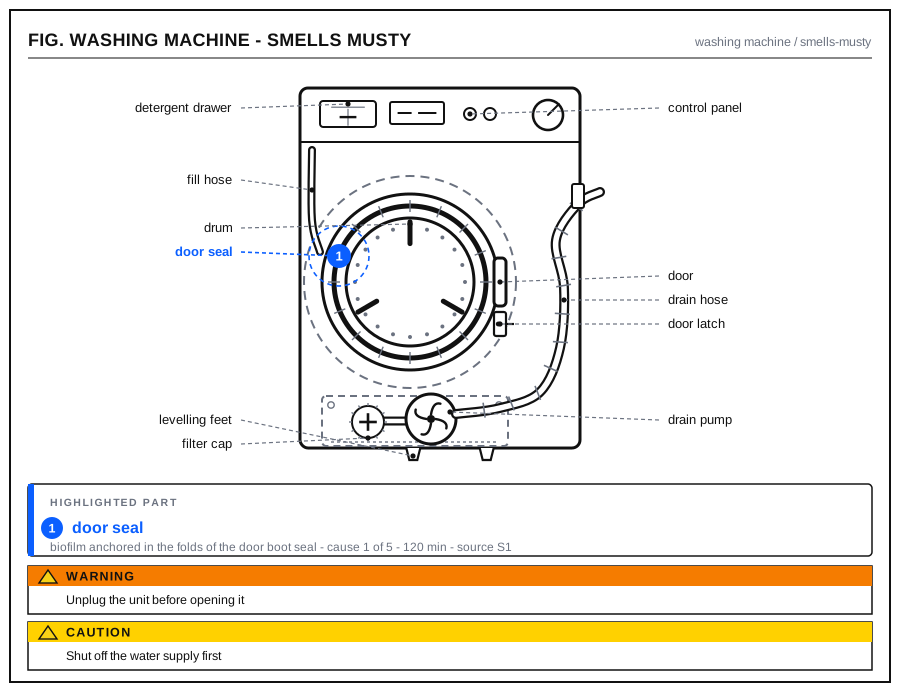
Fig. WASHING MACHINE - SMELLS MUSTY
What a technician actually does
biofilm anchored in the folds of the door boot seal [S1]
high likelihoodadvanced$450 installedabout 120 minn=49 completed jobs[S1]
the rubber seal around the door is black and the smell comes backclean laundry comes out smelling of the machine
The stage the smell is warning about, and the reason a cleaning cycle is the whole answer early and no answer late. The boot is a moulded rubber bellows that seals the drum to the cabinet and flexes through every spin, and its folds are the lowest, darkest and wettest part of the machine - which is where residue collects first and where a film of water sits after the cycle ends with the door shut. The source's own sequence from there has three steps: the smell, which transfers to clean laundry; staining that returns within days of every cleaning because the growth is anchored in the rubber rather than sitting on it; and then degradation of the rubber itself, at which point the boot leaks. That last stage is the expensive one, and this is the most expensive component line in the publisher's washer records - above the motor control board at $436, the drive motor at $387 and the drain pump at $381, and well above the $370 median for washer work as a whole. The invoice is access labour rather than the part: the boot is clamped at the tub with an internal spring band that has to be seated blind, and on most machines the front panel and the door lock assembly come off to reach it. Peeling a working boot back to scrub behind it is how a working boot becomes a leaking one, which is the source's own warning, and it is why this line sits with the technician work rather than with the free checks.
the source prices this as a completed job rather than as a part: a front-load door boot seal runs a $450 median across 49 boot seal jobs, parts, labour and the service call together, so no part-only figure is claimed. The same published table gives the other component lines as medians with no job count behind them, which is why no sample is claimed for those below.
medium likelihoodmoderate$381 installedabout 60 min
the laundry room smells damp after a cyclea cleaning tablet did not get rid of it
The line the source draws between the free checks and the boot: whatever collects in the boot fold works its way to the pump eventually, and a pump that no longer empties the sump leaves the machine wet after every cycle for a mechanical reason rather than a hygienic one. Its published row describes the same part from the other direction - water standing after the cycle, a slow drain or no drain at all - so the test is the same physical one either way: if water is still in the drum hours after the machine finishes, the smell is a symptom of the drain path and this is the repair. No job count is published on this page for the component lines, which is why this cause carries the median and not a sample.
the source prices the drain pump as a completed job at a $381 median - parts, labour and the service call together - and publishes no job count behind that line, so no sample is claimed for it here.
a faulty door lock or lid switch that stops the spin-out [S1]
low likelihoodmoderate$351 installedabout 45 min
clean laundry comes out smelling of the machinethe laundry room smells damp after a cycle
The indirect route, and the one worth naming because both halves of it stand on the same page. Its maintenance list ends with the instruction to take the laundry out promptly, on the grounds that a wet load left in a sealed drum overnight undoes a cleaning cycle; and its published row for the door lock and lid switch is the part behind a machine refusing to spin or start. A machine that will not spin leaves exactly the condition the first item warns about, so a load that comes out dripping and is then left sitting is a musty load however clean the drum is. That is an inference from two published items rather than a claim the source makes about odour, and it is the last cause here because the smell alone rarely points at it - the machine usually announces the fault by not spinning.
the source prices the door lock and lid switch as a completed job at a $351 median - parts, labour and the service call together - with no job count published behind that line on this page.
Repair or replace?
Run the machine's own cleaning cycle monthly, or every 30 loads, whichever comes first - a dedicated Clean Washer cycle rather than a hot wash with an empty drum - with a washer cleaner tablet placed in the drum or liquid chlorine bleach in the bleach compartment; dry the boot and the glass afterwards and leave the door open between uses; check the pump filter behind the bottom front access panel; take the load out promptly instead of leaving it in a sealed drum; and dose an HE detergent to the marked line and no further. That is the whole maintenance answer and it costs almost nothing, which is what makes this page different from the other washer faults: the cheapest line in the publisher's records and the most expensive one are the same part at different stages. The line to watch is the source's own: if the smell survives two consecutive cleaning cycles, if the black staining returns within days of cleaning the boot, if water stands in the drum or under the boot hours after a cycle finishes, if the rubber is cracked, split or torn at the edge, or if there is water on the floor, the problem has moved past the surface and the remaining work is the boot, the sump or the drain path. At that point the arithmetic is still a repair on a machine of any ordinary age: the dearest routine line in the records is a $450 boot against a replacement band starting at $700, so a boot fitted to a machine with years left in it is the cheaper side of the same comparison this site applies everywhere else - but at the top of that labour and at the bottom of the replacement band the two numbers are close enough to price both before approving anything. [S1]
Typical completed repair: $310–$445[S1] — n=4763 completed jobs
Two cuts of the same publisher's washer records sit behind the figures on this page, and they are quoted separately rather than averaged. The record-level band and the boot seal line come from a 4,763-job washer dataset: a $370 median for washer work as a whole with the middle half of jobs at $310-445, and a front-load door boot seal at a $450 median across 49 jobs. The guide for a washer that is leaking prices the same boot seal at a $406 median in that publisher's separate 3,350-job washer dataset, whose all-washer median is $365. Both are the same part and neither is wrong: the two cuts are different samples of the same company's work, which is why one repair carries two prices on this site, and why no figure from one cut is added to a figure from the other.
The comparison here is between a maintenance habit and a parts invoice, and it is the only page on this site where that is true. A cleaning tablet and an open door cost a few dollars a year; the boot they protect is the most expensive routine repair in the publisher's washer records at $450, and the problem it addresses is not rare enough to be theoretical - front-load odour and mould were the subject of a nationwide class action covering roughly 5.6 million Whirlpool, Maytag and Kenmore machines built between 2001 and 2010, settled with preliminary court approval in May 2016, which reimbursed owners who had paid to repair a mouldy machine within five years of purchase up to $500. That is what this repair was costing households a decade ago, and the physics that caused it did not change.
the replacement band and the planning life are the same FlexFul figures used across this site's washing machine pages - a new machine at $700-1,100 against a planning life of about eleven years - and they are the only figures on this page that do not come from the washer dataset above.
a detergent film from over-dosing or a non-HE product [S1]
high likelihoodeasyno part neededabout 10 min
the washer smells musty even after a washa cleaning tablet did not get rid of it
Free to fix, and the most common self-inflicted cause in the source's account, because the machine and the detergent are now specified against each other: a high-efficiency product is formulated for a small volume of water, so an extra dose has nothing to dissolve into and ends up as film on the drum, on the boot and in the dispenser instead of leaving with the water. The manufacturer's own care instruction quoted on the page is to use HE detergent, follow the marked dose and never exceed it, and the page says plainly that over-dosing increases the rate at which detergent and soil residue accumulate inside the washer. Cut the dose to the line and run the machine's own cleaning cycle before anything is ordered.
water standing in the sump behind a partly blocked drain pump filter [S1]
high likelihoodeasyno part neededabout 15 min
the laundry room smells damp after a cyclethe washer smells musty even after a wash
The second free check, and the third item on the source's own maintenance list: most front loaders have a drain pump filter behind a small access panel at the bottom front, and it collects coins, lint and hair. A partly blocked filter leaves water standing in the sump after every cycle, and standing water in the dark is a smell that no amount of drum cleaning reaches. The source's framing is that an odour which returns fast is usually water sitting somewhere it should not be - under the boot, in the sump or behind that filter - and that this is a diagnosis rather than a cleaning problem. Put a shallow tray under the panel before opening it, because the housing holds water. This is also the check that separates a hygiene problem from the drain path below it.
What each fix costs
Cause
Cost
Time
DIY?
a detergent film from over-dosing or a non-HE product
no part needed
10 min
easy
water standing in the sump behind a partly blocked drain pump filter
no part needed
15 min
easy
a faulty door lock or lid switch that stops the spin-out
$351 installed
45 min
moderate
a drain pump that no longer clears the sump
$381 installed
60 min
moderate
biofilm anchored in the folds of the door boot seal
$450 installed
120 min
advanced
A technician visit starts with a diagnostic fee of $99 [S1]. Completed repairs run $310–$445 [S1].
Sources
[S1]Bozmanfix (medians from completed washer jobs; component medians published with a job count only where the sample supports one; published 1 September 2026) (2026-09). the 4,763 completed washer repairs behind the table, the $370 median for washer work as a whole with the middle half of jobs at $310-445, the front-load door boot seal at a $450 median across 49 jobs (described as the most expensive component line in the washer dataset), the component medians with no job count published - motor control board $436, drive motor $387, drain pump $381, tub bearing $380, water inlet valve $362, door lock and lid switch $351 - the $99 diagnostic applied to the repair when it is approved, the Whirlpool maintenance instruction (a Clean Washer cycle monthly or every 30 loads with a washer cleaner tablet in the drum or liquid chlorine bleach in the bleach compartment, HE detergent dosed and never over-dosed, the door left open between uses, the laundry taken out promptly), the drain pump filter check behind the bottom front access panel and the finding that a partly blocked filter leaves water standing in the sump, the ENERGY STAR water figure (roughly 50 percent less water, about 14 gallons a load against 20), the three-step boot sequence from smell to staining to degraded rubber, the note that a boot replacement is access labour because the internal spring band is seated blind and the front panel and door lock come off, the warning that peeling a boot back to scrub behind it is how a working boot becomes a leaking one, the stop-and-call list, the 90-day parts and labour warranty, and the class action covering roughly 5.6 million Whirlpool, Maytag and Kenmore front loaders built between 2001 and 2010 with preliminary court approval in May 2016 and reimbursement of mould repairs up to $500
[S2]FlexFul Appliance Repair (Chicagoland) (2026). the replacement band for a new washing machine used in the decision arithmetic ($700-1,100) and the planning life of about eleven years, both consistent with the other washing machine pages on this site
Last verified: 2026-09-19. Prices are US market figures from the sources above; your quote may differ.
Built from a fact record, not from a template: every number above is tied to one of the sources and the record is re-checked against them. Editorial choices (which symptom leads, which cause is the single tell) are kept in a separate block so the facts stay auditable.
Quick answers
How much does it cost to fix a washing machine with this problem?
Completed repairs run $310–$445 according to the sources cited on this page, after a diagnostic fee of $99.
How long does a washing machine last?
The decision rule used on this page works from a planning life of 11 years.
Repair or replace?
Run the machine's own cleaning cycle monthly, or every 30 loads, whichever comes first - a dedicated Clean Washer cycle rather than a hot wash with an empty drum - with a washer cleaner tablet placed in the drum or liquid chlorine bleach in the bleach compartment; dry the boot and the glass afterwards and leave the door open between uses; check the pump filter behind the bottom front access panel; take the load out promptly instead of leaving it in a sealed drum; and dose an HE detergent to the marked line and no further. That is the whole maintenance answer and it costs almost nothing, which is what makes this page different from the other washer faults: the cheapest line in the publisher's records and the most expensive one are the same part at different stages. The line to watch is the source's own: if the smell survives two consecutive cleaning cycles, if the black staining returns within days of cleaning the boot, if water stands in the drum or under the boot hours after a cycle finishes, if the rubber is cracked, split or torn at the edge, or if there is water on the floor, the problem has moved past the surface and the remaining work is the boot, the sump or the drain path. At that point the arithmetic is still a repair on a machine of any ordinary age: the dearest routine line in the records is a $450 boot against a replacement band starting at $700, so a boot fitted to a machine with years left in it is the cheaper side of the same comparison this site applies everywhere else - but at the top of that labour and at the bottom of the replacement band the two numbers are close enough to price both before approving anything.