Automatic follows the operating system setting. Light and dark override it and are remembered in this browser.
Symptom guide / washing machine
Water on the floor around the washing machine
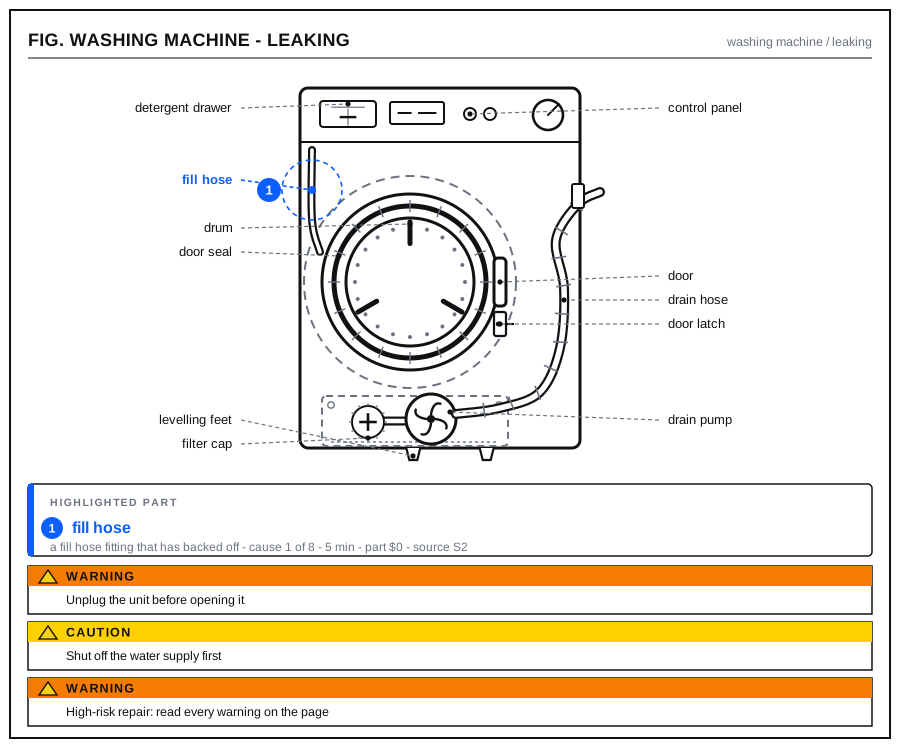
Where the water appears is the diagnosis, and the two cheapest causes behind a washer leak are both about things that have not failed: a fitting that has backed off, and too much detergent pushing suds past seals that are still doing their job. A fill hose fitting that has backed off: 5 minutes, no part needed [S2] — the first of 2 causes on this page that need no part at all. On a washing machine the complaint is water on the floor around the washing machine, and it arrives in these words: there is water on the floor around the washer, it leaks only during the drain and spin, water comes out at the front of the door, the floor under the machine is wet after every wash or it leaks from the back where the hoses connect. Until that check comes back clean, every price below is premature — the completed repairs behind this symptom run $362–$406 [S1], against a replacement from $700.
What the fault looks like
Fig. WASHING MACHINE - LEAKING
What a technician actually does
torn or moldy door boot seal on a front loader [S2]
medium likelihoodmoderate$150–$350 installedabout 90 minn=62 completed jobs[S1]
water comes out at the front of the doorthere is water on the floor around the washer
The front-loader equivalent of the door gasket, and the one leak that is visible without moving the machine: the source's instruction is to clean a mouldy boot and replace it only if it is torn or rotted, because a seal that is merely dirty leaks nothing. Water at the door during the wash points here rather than at the drain path. The second source's completed jobs put this at the dearest of the three leak-related parts it prices, at a $406 median across 62 jobs - and the gap between the $150-350 published band and the $406 invoice is the access labour, which is the same story on every page of this site.
the second source prices the boot as a completed job at $150-350 installed; the first source's records put a door seal or boot replacement at a $406 median across 62 completed jobs, and neither publishes a part-only figure, because the invoice is dominated by pulling the front panel and the door apart
it leaks only during the drain and spinthere is water on the floor around the washer
The timing identifies it: water that appears only once the machine starts draining or spinning is on the drain side, not the fill side, and a split drain hose or a clamp that has come off the pump outlet leaks at exactly that moment. Reseating the clamp is free; a split hose is a $15-40 part. The source's caution is the same as for the fill side - age, not use, is what splits a hose.
medium likelihoodmoderate$362 installedabout 50 minn=104 completed jobs[S1]
it leaks from the back where the hoses connectthere is water on the floor around the washer
The distinction that decides whether this page costs $30 or $360: the hose connects to the valve, and a leak at the back is a hose problem until the hose has been checked and replaced. The valve itself leaks when its body or its seals have failed, which is a different job and one of the most common repairs in the source's whole washer dataset - 104 completed jobs at a $362 median. Anyone ordering a valve before tightening or replacing the hose has skipped the cheap half of the diagnosis.
no part-only figure is published by either source; the first source's completed jobs put a water inlet valve replacement at a $362 median across 104 jobs, with the trip, the diagnosis and the access included
medium likelihoodadvanced$150–$400 installedabout 150 min
the floor under the machine is wet after every washit leaks only during the drain and spin
The cause behind water that appears underneath the machine rather than at its front or back, and the one that turns a cheap leak into an expensive one: a worn seal at the pump or the drum lets water out at the bottom of the cabinet, where it soaks the base and the floor before anyone sees it. The source's framing for why the invoice is what it is applies directly here - on a front loader, reaching the pump or the outer seal means pulling the front panel and often the door boot, and that labour lands on the bill regardless of which part turned out to be at fault.
the second source prices a pump or drum seal at $150-400 installed; the first source's records put a drain pump replacement at a $374 median across 127 jobs, which is the same access with a new pump at the end of it
Repair or replace?
The verdict
Find the leak before pricing it, because the location is the diagnosis. Water at the back is the fill hose first and the inlet valve second; water at the door during the wash is the boot; water only during the drain and spin is the drain hose or the pump; water underneath is the pump or tub seal. Then take the cheap column before the expensive one - tightening or replacing a supply hose, fitting a new drain hose, cutting the detergent dose and clearing the drawer are all under $60 together, against a $362-406 repair if a valve, a pump or a boot is ordered first. At $362-406 against a $700-1,100 machine, every one of those repairs is inside half the replacement price, so on a machine under about eight years old the arithmetic says repair whichever part it turns out to be. [S1]
Washer leaking jobs overall, the 4,763-job deep-clean set, from a second published dataset: $354 median — the source publishes no middle half for this row [S4] — n=482 completed jobs[S4]
Two of the eight causes on this page carry a published job count, both from the same publisher's washer repair cost table: the door seal or boot at 62 jobs and the water inlet valve at 104. The other six carry none, and the reason is the table's own scope - it prices part replacements, so a fill-hose fitting that has backed off, an aged fill hose, oversudsing, a loose drain hose and a clogged dispenser have no row to be counted on, and the source publishes cells only where at least ten completed jobs support them. The six remaining causes are described by a second source that publishes a likelihood word and a price for each and no number of jobs at all. Six of eight causes therefore stand without a denominator, stated rather than estimated. Beside that table the same publisher's deep-clean page publishes a second band for the whole washer-leaking symptom: a $354 median across 482 completed leak repairs from its own 4,763-completed-repair front-load dataset, and it publishes no middle half for that row. That 4,763-job deep-clean set is a different dataset from the 3,350-job cost table behind the headline band, so the two bands stand side by side and are never added together.
The arithmetic on this page is not close, and the risk is not the repair bill. The dearest leak-related repair in the records is a door seal or boot at $406, which is inside half the price of the cheapest new machine the cited source prices - so the decision on cost alone is repair, and the age of the machine is what changes it. What makes this page different from the others is the downside on the other side of the ledger: this is the one fault on this site where the cheapest cause carries the largest risk, because a supply hose runs at household pressure and a burst one pours water onto the floor until somebody notices. The source's own answer is that a $10-40 braided hose is cheap insurance against a flood, and that the supply valves should be shut off whenever the machine is left for a trip.
the replacement band and the planning life are from the same repair-cost source used across this site's washing machine pages (FlexFul, 2026): a new machine at $700-1,100 against a planning life of about eleven years.
Have a quote?
Put your quote and the age of the unit into the calculator — the same half-of-new-price rule, with your own numbers.
it leaks from the back where the hoses connectthere is water on the floor around the washer
The source's first instruction is the free one: a fitting that has backed off is a two-minute hand-tightening, and it is the most common cause in its own ranking. Do that first and dry the floor, because a leak that stops is a leak that was the fitting and not the hose. The other half of the same visit costs nothing either - feel the hoses while you are behind the machine, since the source's warning is that rubber hardens with age and splits, and a hose that has gone stiff is the next cause on this list whether it is leaking today or not.
it leaks from the back where the hoses connectthere is water on the floor around the washer
A $10-40 part and the cause with the largest downside on this page relative to its price, because a supply hose runs at household pressure rather than at whatever the drain pump produces. The source's advice is to replace old rubber hoses with braided stainless rather than with more rubber, and to treat age rather than use as the thing that ends a hose's life. This is also the cheapest insurance on the page against the failure that costs the most - water on the floor until somebody notices.
there is water on the floor around the washerthe floor under the machine is wet after every wash
Free to fix and easy to miss, because nothing has failed: too much detergent, or a non-HE detergent in a high-efficiency machine, produces suds that push water past seals that are working correctly. The leak then appears in a place that points at a part - at the door, or under the machine - which is why this cause is worth eliminating before anything is ordered. Switching to an HE detergent and cutting the dose to the recommended line is the whole fix.
cracked dispenser or clogged detergent drawer [S2]
low likelihoodeasy$0–$60 partabout 15 min
water comes out at the front of the doorthere is water on the floor around the washer
The last cause and the cheapest to rule out: a clogged drawer overflows and a cracked dispenser dribbles down the front of the machine, which looks like a door leak from standing height. Clearing the drawer costs nothing and replacing a cracked one is at most $60, so this is worth eliminating before a boot or a seal is ordered.
What each fix costs
Cause
Cost
Time
DIY?
a fill hose fitting that has backed off
no part needed
5 min
easy
oversudsing from too much detergent
no part needed
10 min
easy
cracked dispenser or clogged detergent drawer
$0–$60 part
15 min
easy
aged rubber fill hose that has split
$10–$40 part
15 min
easy
cracked or loose drain hose
$15–$40 part
20 min
moderate
torn or moldy door boot seal on a front loader
$150–$350 installed
90 min
moderate
failed pump seal or tub seal
$150–$400 installed
150 min
advanced
water inlet valve
$362 installed
50 min
moderate
A technician visit starts with a diagnostic fee of $99 [S1]. Completed repairs run $362–$406 [S1].
Sources
[S1]Bozmanfix (first-party records from completed work orders; page published 2026) (2026). the 3,350 completed washer repairs behind the dataset, a $365 median washer repair with the middle half of jobs between $310 and $430, the $99 diagnostic applied to the repair, and the per-repair medians with their job counts: a water inlet valve at $362 across 104 jobs, a drain pump at $374 across 127, a motor at $384 across 23, a door latch at $390 across 14, a door seal or boot at $406 across 62, a control board at $439 across 112 and a drive belt at $327 across 38. Also the by-brand and by-state medians, the rule that no figure with fewer than ten jobs behind it is published, the statement that medians come from completed repairs where a part was installed, the explanation that a drain pump retailing around $45 arrives at $374 on the invoice, and the access observation that reaching the pump or the outer seal on a front loader means pulling the front panel and often the door boot
[S2]OnOtto (home maintenance symptom guides; page updated August 2026) (2026-08). the ranked cause list with a fix and a typical cost for each: a loose or aged fill hose as most common at $10-40 for the replacement, oversudsing as free to fix, a torn or mouldy door boot at $150-350 installed, a cracked or loose drain hose at $15-40, a failed pump or tub seal at $150-400, and a cracked dispenser or clogged drawer at $0-60. Also the location rule (a leak at the back points at hoses and a leak at the door points at the boot), the instruction to clean rather than replace a mouldy boot, the advice to fit braided stainless hose once rubber hoses are old, and the safety framing that a supply hose runs at household pressure so a burst one can pour several gallons a minute
[S3]FlexFul Appliance Repair (Chicagoland) (2026). the replacement band for a new washing machine used in the decision arithmetic ($700-1,100) and the planning life of about eleven years, both consistent with the other washing machine pages on this site
Built from a fact record, not from a template: every number above is tied to one of the sources and the record is re-checked against them. Editorial choices (which symptom leads, which cause is the single tell) are kept in a separate block so the facts stay auditable.
Quick answers
How much does it cost to fix a washing machine with this problem?
Completed repairs run $362–$406 according to the sources cited on this page, after a diagnostic fee of $99.
How long does a washing machine last?
The decision rule used on this page works from a planning life of 11 years.
Repair or replace?
Find the leak before pricing it, because the location is the diagnosis. Water at the back is the fill hose first and the inlet valve second; water at the door during the wash is the boot; water only during the drain and spin is the drain hose or the pump; water underneath is the pump or tub seal. Then take the cheap column before the expensive one - tightening or replacing a supply hose, fitting a new drain hose, cutting the detergent dose and clearing the drawer are all under $60 together, against a $362-406 repair if a valve, a pump or a boot is ordered first. At $362-406 against a $700-1,100 machine, every one of those repairs is inside half the replacement price, so on a machine under about eight years old the arithmetic says repair whichever part it turns out to be.